
Fall is the easiest building season on the Peninsula because the soil is dry, the weather is predictable, and the summer rush has cleared off the calendar. A fence is only as good as the ground it stands in and the conditions it was built under. September and October give crews both. Once the storms arrive, every one of those advantages disappears at the same time.
Here's the short version:
- Dry clay, dry holes and dry wood are what good fence work depends on.
- Permit review takes time, so September beats November as a starting point.
- Walking your fence line now shows you which sections will not survive the first storm.
What Dry Ground Does for a Post Hole
Most of this county sits on clay. In the fall, that clay is firm and compacted after months without rain. When a crew augers a hole, the walls stay where they are cut. The hole keeps its shape, the depth is consistent from post to post, and the post sits in a tight pocket of soil that holds it plumb while the concrete sets.
Wet clay behaves like a completely different material. It swells, it smears, and the sides of a fresh hole slump inward before a post ever goes in. On a sloped lot in San Carlos or Belmont, a saturated hillside also moves under foot, which makes it harder to hold a straight line across a long run. Crews can work in those conditions, but nothing about it is easier, faster or cleaner.
Dry ground also means equipment and boots stay off soft lawns and planting beds. Less mud tracked across a yard means less cleanup and less damage to the landscaping you already paid for.
Why this matters most on hillside lots
Hillside properties in the San Bruno, Millbrae and Belmont hills are where the difference is sharpest. Grade changes mean stepped or racked panels, more careful layout, and more time spent getting each post right. Doing that work on firm ground is straightforward. Doing it on a slope that is shedding water is slow and unpleasant for everyone.
Concrete, Stain and Sealer Behave the Way They Should
Post concrete needs to cure, not soak. A hole with standing water in the bottom is not a good home for a setting post. Fall conditions on the Peninsula give crews dry holes and steady daytime temperatures, which is exactly what you want under a fence that has to stand for years.
Finishes are the same story. Stain and sealer need dry wood and dry air to penetrate and set up. Apply a finish to redwood or cedar that is still holding rain and the coating sits on a damp surface instead of soaking into it. Fall is the window where a new wood fence can be built and finished back to back, without waiting on the weather in between. The same logic applies to anything you want to keep protected through winter, including decks, arbors and gates.
If you are also thinking about how the fence will look once it is up, the design choices are easier to picture while the yard is dry and open. Our guide to creative fence design ideas for Bay Area homeowners is a good place to sort out style before a crew ever arrives.
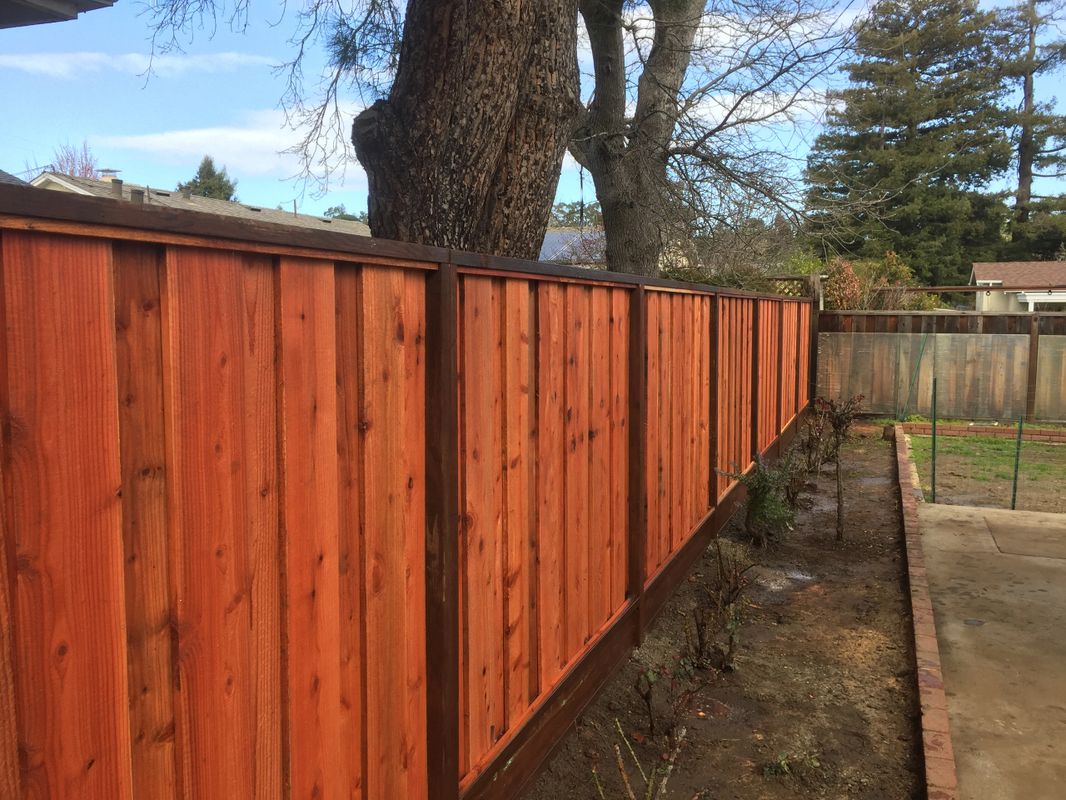
A new wood fence line running along a dry Peninsula backyard slope in early fall.
What Changes Once the Storms Start
The first atmospheric river of the season resets everything. Hillside lots turn to mud, holes fill with water, finishes cannot be applied, and any job that was in progress pauses. When a crew loses days to weather, the jobs behind it slide too. A project that would have run straight through in October can stretch across weeks in January for reasons nobody controls.
There is also a scheduling reality. Summer is the busy season for fence and deck work across the Peninsula. By late September that rush has eased, so there is genuine room on the calendar. That room shrinks again as soon as homeowners start calling about fences that blew over in the first big wind event.
| Condition | Fall on the Peninsula | After the rains start |
|---|---|---|
| Post holes | Clay holds shape, clean sides | Walls slump, water collects |
| Concrete | Cures under dry conditions | Sits in wet or standing water |
| Stain and sealer | Dries and penetrates | Cannot be applied to wet wood |
| Crew schedule | Continuous work, no rain days | Jobs pause and slide |
| Hillside access | Firm footing | Mud and unstable grade |
| Yard impact | Minimal tracking | Mud across lawns and beds |
Permits Take Time, So Start the Clock Early
Fall is also the right time to start because paperwork does not move at the speed of good weather. Most decks require permits, and we handle that process as part of our service. Fence permit rules vary from city to city across the county, and taller front yard fences are the most common place a homeowner runs into a requirement they did not expect. Our complete guide to fence permits in San Mateo County walks through what to check before you settle on a height or a location.
The practical point is simple. If a permit needs to move through a city before construction begins, starting that in September means the building happens in dry weather. Starting it in November means the building happens whenever the rain lets up.
One more fall consideration
Fire season on the Peninsula peaks in September and October, when the hills are dry and offshore winds arrive. The State Fire Marshal 2025 Fire Hazard Severity Zone maps designate Moderate, High and Very High zones in the hills of San Bruno (adopted by the city in July 2025), Millbrae and Belmont, so homes there fall under California defensible space and home hardening rules.
Cal Fire guidance treats the first five feet around a home as Zone 0, the ember resistant zone. Nothing combustible belongs there, and combustible fencing or gates attached to the house should be replaced with noncombustible material such as aluminum. That statewide Zone 0 regulation is still being finalized, so it is guidance rather than a law in force.
If you are in one of those zones, fire safe aluminum fencing is worth discussing while you are already planning fall work. Aluminum does not ignite and does not carry flame. Vinyl is PVC plastic, and while it does not carry flame the way dry wood does, it softens and deforms in high heat, so it is not a fire safe material. Our guide to how fire safe aluminum fencing works in San Mateo County wildfire zones covers the details.
Walk Your Fence Line Before the First Storm
Walk the whole perimeter before the weather turns. Push on the posts. Look for leaning sections, split rails, sagging gates that no longer latch, and any place where the fence is doing less work than it used to. Those are the sections most likely to fail in the first strong wind and rain.
A-1 Fence and Deck Inc. has been family owned in South San Francisco since 1978, licensed under CSLB #998389 and fully insured and bonded. We are rated 4.8 stars from 198 Google reviews. We install wood, iron, chain link, vinyl and aluminum fencing from San Francisco down the Peninsula to Palo Alto and Mountain View, and we build decks, gates, arbors and pergolas too.
If you want the work done in dry weather, now is the window. Call (650) 873-7272 or request a free estimate from A-1 Fence and Deck.
FAQs
Is fall really better than spring for fence installation here?
Fall gives you dry ground after months without rain, which is the best condition for setting posts and applying finishes. Spring can be good once things dry out, but the soil is often still holding water from winter storms. Fall also has more room on the schedule because the summer rush has passed.
What happens if rain starts in the middle of my project?
Work pauses until conditions allow the crew to continue safely and correctly. Posts, concrete and finishes all need dry conditions to be done properly. Starting early in the fall is the simplest way to avoid that situation entirely.
Do I need a permit for my new fence or deck?
Most decks require permits, and we handle that process for you as part of our service. Fence permit requirements depend on your city, height and location, with taller front yard fences being the most common place homeowners run into a requirement. We can tell you what applies to your property during the estimate.
How long does a wood fence last in this climate?
With proper maintenance, our wood fences typically last 15 to 20 years. Redwood and cedar naturally resist rot and insects, which extends lifespan further. Building and sealing during dry fall weather gives a new fence the best possible start.
Can you install on a sloped hillside lot?
Yes. Aluminum fencing is especially well suited to slopes because panels can be racked to follow the terrain smoothly, and we build wood and iron fences on grade as well. Sloped lots are considerably easier to work on when the ground is firm, which is another argument for scheduling before the rains.